
Enfield's economy grew 0.2% a year from 2013 to 2023, London's 1.7%. Cabinet's plan to 2040 backs four sectors and 15 measures, but sets no target figures.
Enfield’s economy grew by only 0.2% a year in real terms between 2013 and 2023, while London’s grew by 1.7% a year. That figure, from Greater London Authority estimates, opens the case for the council’s new Economic Growth Plan, which Cabinet approved on Wednesday 14 October. (Enfield Council, Economic Growth Plan 2040)
The plan’s stated aim is that “by 2040, Enfield will be London’s leading industrial and entrepreneurial borough”. Cabinet approved it and handed its delivery to the Executive Director of Housing and Regeneration, working with the Cabinet member for planning and regeneration. (Enfield Council, Cabinet decision sheet)
What the plan says is wrong
The plan is frank about the borough’s weak spots. Its own figures:
- Slow growth. Real output grew 0.2% a year from 2013 to 2023, against 1.7% for London.
- Low pay. 21% of jobs in Enfield are paid below the London Living Wage, the third highest share in Outer London.
- Shrinking big employers. Retail and education, together more than 20% of jobs, have contracted over the decade. Health, the largest sector at more than 15% of jobs, has seen “little or no growth”.
- Skills. 22% of residents have no formal qualifications, which the plan says is a higher share than every local, regional and national average.
- An east-west divide. 44% of residents live in neighbourhoods among the 20% most deprived nationally, “almost all of which are in the East of the borough”.
- Broadband. Full fibre reaches 69.8% of the borough, against 78.4% across London, though that is up from 3% five years ago.
What it says is going right
The plan also lists real strengths. Enfield has about 14,000 businesses, and over 99% of them employ fewer than 50 people. It has the fourth largest amount of industrial land of any London borough, and one in 16 jobs here is in logistics. The working-age population grew 19% between 2011 and 2021, against 5% across Outer London.
It names Greggs twice: once among the food and drink makers “continuing to provide the daily bread of London”, and once as a “key business anchor” on the industrial estates. Greggs proposed on 30 September to close its Enfield Bakery in Brimsdown, as we reported at the time. The plan does not mention that proposal.
The four sectors it backs
The plan picks four priority sectors, chosen for recent growth and fit with the borough:
- future-facing manufacturing
- construction and net zero
- logistics and wholesale
- creative industries
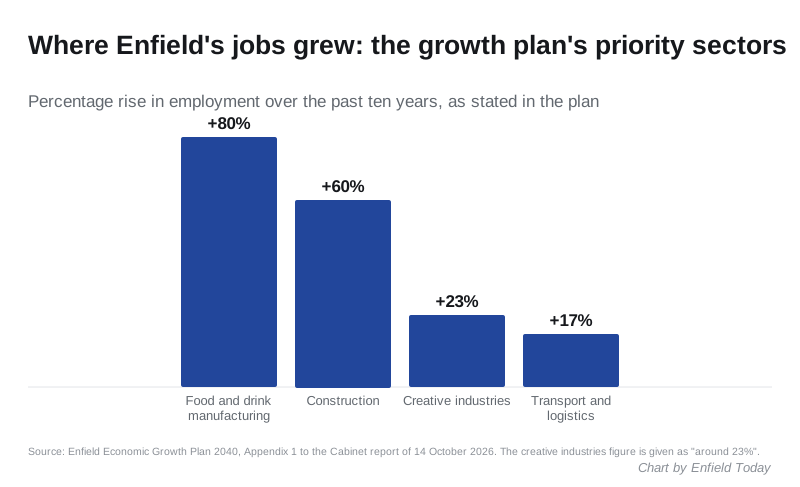
The plan’s own figures for jobs growth over the past ten years:
- food and drink manufacturing supports 3,000 jobs, up 80% in a decade
- construction supports 8,000 jobs, up 60%, the fastest-growing sector
- creative industries jobs are up “around 23%”, about five times the Outer London rate; the plan points to OMA X, which it calls the largest film studio in London
- transport and logistics jobs are up 17%
Health, care, education, retail and the visitor economy stay in the plan as “foundational” sectors. Hospitality, arts and recreation support around 10,000 jobs, the plan says.
What the council says it will do
The plan sets out actions under three headings. Among them:
- tailored support for each priority sector on skills, workspace, supply chains and investment
- protecting and adding affordable, flexible workspace, including on council land
- a “Brand Enfield” to market the borough to investors
- working with Energetik and network operators on grid capacity, which the plan calls a barrier to investment on the industrial estates
- lobbying for better rail services, including at Meridian Water and on Great Northern routes, and better east-west public transport
- employment and skills help run from libraries, estates and community and faith venues in the east of the borough
A new Strategic Partnership Board is being set up to oversee it. The council’s Overview and Scrutiny Committee looked at a draft on 7 September.
How it will be measured
The plan lists 15 indicators to track progress, five under each priority. They include output per hour worked, business survival rates, full fibre and 5G coverage, 16 and 17-year-olds not in education or work, and the employment rate. (Enfield Council, Appendix 2)
The plan says these measures were chosen so that “the targets are realistic but ambitious”. Neither the plan nor its indicator table gives a target figure for any of them. There is no number for 2040, or any year before it, that residents could check the council against.
What it means for you
If you run a business in Enfield, the plan promises a joined-up offer through Enterprise Enfield, Grow London Local and the Business and Intellectual Property Centre. It comes with no new money. The Cabinet report says there are “no specific financial implications” in the short term, with council departments folding the plan into their day-to-day work. (Enfield Council, Cabinet report KD 6125)
If you are looking for work or training, the plan’s most specific promises are for young people and for the east of the borough: more apprenticeships, work experience and careers events, and help with childcare, health and housing barriers. Our page on the council’s Cabinet decisions this month has the other items agreed the same night.
If you want to follow progress, the council says Cabinet will monitor the indicators through its corporate performance dashboard. Its next quarterly performance report is the place to look.
Have your say