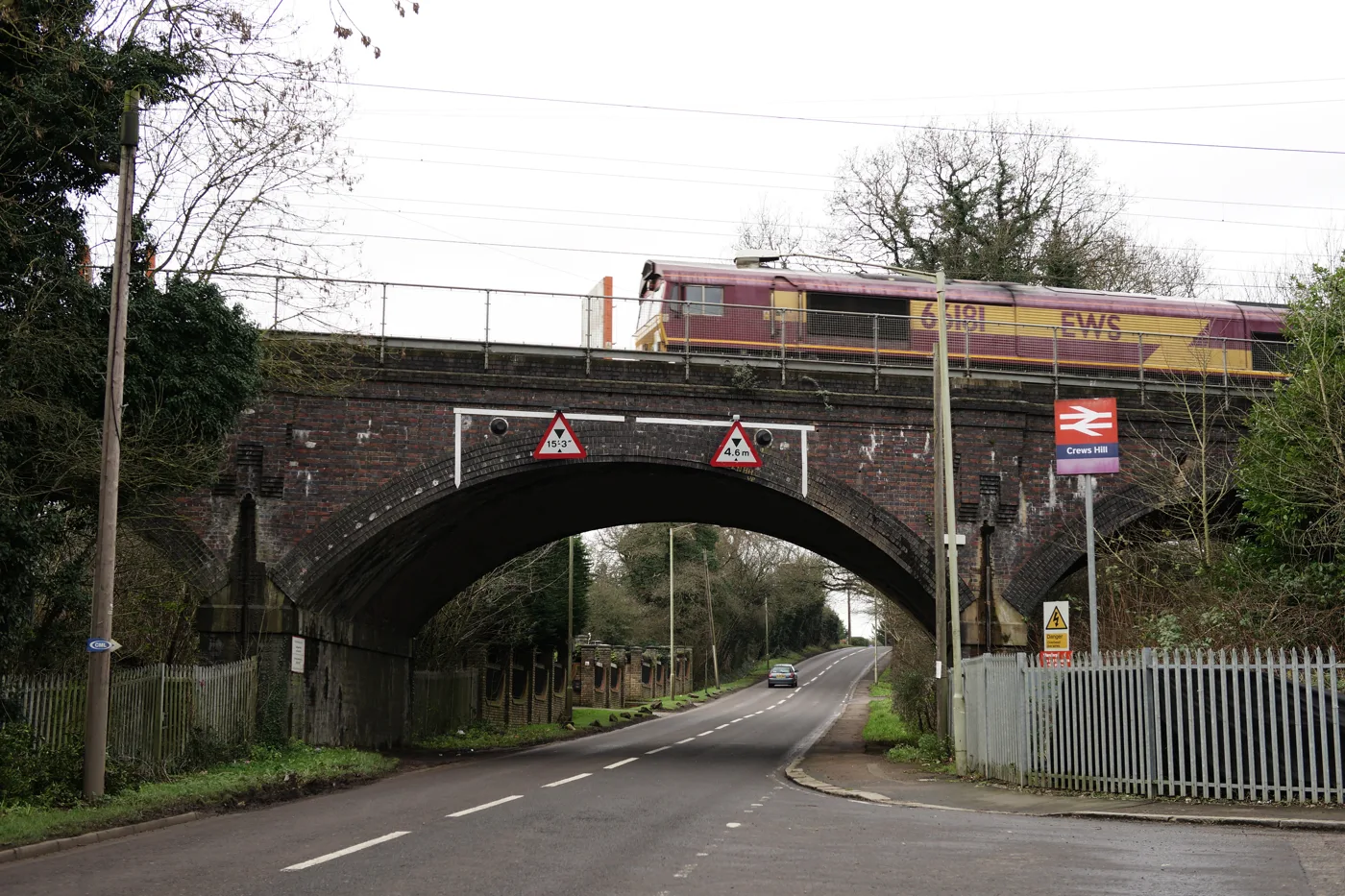

The Local Plan inspector has told Enfield to keep Kings Oak Plain and most of the golf course in the green belt. 35,162 homes proposed, consultation due later in 2026.
Enfield’s new Local Plan is the document that decides where the borough builds for the next fifteen years, and it is at the sharp end of its examination. The hearings finished in March. The inspector wrote back in June. What he wrote matters most at Crews Hill, where he has told the council it cannot take as much land out of the green belt as it wanted.
This page sets out where the plan stands, the numbers behind it, and the two schemes that decide what the borough looks like: Crews Hill and Meridian Water. Everything here comes from the examination’s own documents.
Where the Local Plan has got to
The Enfield Local Plan 2019 to 2041 was submitted for independent examination and heard by inspector Steven Lee across three stages of hearings through 2025, followed by a short focused set on 18 and 19 March 2026.
- 19 March 2026: hearing sessions close.
- 15 June 2026: the inspector issues IN14, his post-hearing advice, setting out the further main modifications needed to make the plan sound.
- 29 June 2026: the council replies. It confirms it will carry on, notes that “there has been a change in the political administration of the Council” since the hearings closed, and says work is underway on the schedule of main modifications, with public consultation on them expected later in 2026.
Nothing is adopted yet. A plan reaches force only after the modifications are consulted on and the inspector issues his final report. Until then Enfield is still deciding applications against its older adopted documents.
The number: 35,162 homes, and a target already missed
The plan’s housing trajectory, as updated for the inspector, proposes 35,162 new homes across the plan period to 2040/41.
The problem is the near term. The London Plan sets Enfield a target of 1,246 homes a year, or 12,460 over the ten years to 2028/29. The borough has not come close to it in any single year.
| Year | Completions | London Plan target | Cumulative shortfall |
|---|---|---|---|
| 2019/20 | 429 | 1,246 | -817 |
| 2020/21 | 847 | 1,246 | -1,216 |
| 2021/22 | 755 | 1,246 | -1,707 |
| 2022/23 | 894 | 1,246 | -2,059 |
| 2023/24 | 876 | 1,246 | -2,429 |
| 2024/25 | 1,102 | 1,246 | -2,573 |
| 2025/26 | 796 | 1,246 | -3,023 |
| 2026/27 | 779 | 1,246 | -3,490 |
| 2027/28 | 1,288 | 1,246 | -3,448 |
| 2028/29 | 1,437 | 1,246 | -3,257 |
Figures from 2025/26 onwards are the council’s projections rather than completed counts. The council’s own conclusion, in its note to the inspector, is blunt: the London Plan ten-year target will not be achieved by 2029, but will be achieved by 2031. The cumulative shortfall turns into a surplus of 518 homes in 2030/31.
The inspector’s view on all this is that the shortfall does not require the plan to build more. Because there is “supply headroom”, he wrote, “it is not necessary for the overall housing requirement to change”. What he does want is a revised stepped trajectory that keeps to the London Plan annual figure up to 2029 and then spreads the accumulated shortfall across the rest of the plan period.
One detail worth noting from the council’s review of its own numbers: 110 planning permissions in the trajectory had lapsed, with a combined capacity of 367 homes. They have been taken out of the supply.
Crews Hill: the inspector pushes back on green belt release
Crews Hill, the nurseries-and-garden-centres belt at the top of the borough, is the plan’s most contested allocation. The plan proposes taking it out of the green belt to build a new neighbourhood. In IN14 the inspector accepts the principle but repeatedly refuses the extent, on the ground that green belt land can only be released where “exceptional circumstances” exist, and they do not exist for land nobody intends to build on.
What he told the council to change:
- Kings Oak Plain must stay in the green belt. It is not part of the developable area and does not need releasing for open space, biodiversity or landscaping.
- Most of the golf course must stay too. It is a Grade I Site of Importance for Nature Conservation, and the plan’s promise to build only on “areas of lowest ecological value” was found “vague”, with “little to limit development taking place within the wider golf course”.
- The railway corridor SINC should keep its green belt status except where a fragment would be left isolated.
- The Glasgow Stud SINC should only lose green belt status where development is actually intended.
- Parcel SA11.6: the land east of Theobalds Park Road and inside the conservation area is not identified for housing, so there are no exceptional circumstances to release it.
The inspector also offered the council an alternative he says he would accept: keep the whole SA11.2 area in the green belt, with Cattlegate Road and the edge of the SINC along the railway forming the new boundary. That would cost the scheme 200 dwellings, which he judged would not undermine the case for the wider development.
Two further changes affect how Crews Hill would be built. The plan must say where higher densities and taller buildings are and are not appropriate, rather than leaving it to a later masterplan; and the reference to “exploring” Gypsy and Traveller pitches must come out of both Crews Hill and Chase Park, because that was never part of the case for releasing the land.
Separately, several Rural Enfield allocations were found unsound in principle. The inspector concluded they are “not effective and are not capable of being made so through modification” and told the council to delete them, folding what they were trying to achieve into a general policy instead. He was explicit that this has no bearing on permissions already granted.
Meridian Water
Meridian Water, the council’s own regeneration scheme on the Lea Valley side of Edmonton, is made up entirely of site allocations, and the inspector wants the plan to say plainly what scale of development is expected there rather than leaving it to a masterplan. He also wants flexibility on offices: the plan’s 40,000 sqm office requirement is all located at Meridian Water, and with limited evidence of strong demand for offices in the borough he warned that “overly stringent office requirements on Meridian Water could unreasonably stymy development coming forward on this important regeneration site”.
Industrial floorspace: the target comes down
One number in the plan is being cut outright. Policy SS1 sets a requirement of at least 304,000 sqm of net additional industrial and logistics floorspace over the plan period, based on completions between 2016 and 2021.
The inspector found that five-year base “not truly reflective of past trends” and “unduly optimistic”, and ruled the figure unjustified. He directed the council to rebase it on 2016 to 2024, which the council’s own hearing statement puts at just over 250,000 sqm, or 9,775 sqm a year. That is roughly a 54,000 sqm reduction in what Enfield must plan for.
Whitewebbs: permission quashed
Outside the Local Plan, the borough’s biggest planning decision this summer went the other way. On 27 July 2026 the High Court quashed the planning permission granted to Tottenham Hotspur for a football academy on the former Whitewebbs Park Golf Club site, after the council withdrew from defending the judicial review.
Cllr Alessandro Georgiou, leader of the council, said: “This new Administration pledged to protect Whitewebbs Park from unacceptable development and ensure it remains accessible for local residents and communities to enjoy. That is why we withdrew from defending this Judicial Review.”
How to check or comment on an application
Enfield’s planning register is at planningandbuildingcontrol.enfield.gov.uk, where you can search by address, reference or week, read the officer’s documents and submit a comment. The weekly list of newly validated applications is the fastest way to see what has just been put in near you.
Local Plan examination documents, including every letter quoted on this page, are published on the council’s Local Plan page.
Frequently asked questions
What stage is the Enfield Local Plan at?
Examination hearings closed on 19 March 2026. The inspector issued his post-hearing advice on 15 June 2026 and the council replied on 29 June, saying it is preparing the schedule of main modifications with public consultation expected later in 2026. The plan is not adopted.
How many homes does the Enfield Local Plan propose?
35,162 over the plan period to 2040/41, according to the council’s updated housing trajectory. The London Plan target for the ten years to 2028/29 is 12,460, or 1,246 a year.
Is Enfield building on the green belt at Crews Hill?
Partly, but less than the plan proposed. The inspector has told the council to keep Kings Oak Plain, most of the golf course, the railway corridor SINC and parts of the Glasgow Stud SINC in the green belt, because there are no exceptional circumstances to release land nobody intends to build on.
Is Enfield meeting its housing target?
No. Completions have fallen short of the 1,246-a-year London Plan requirement in every year since 2019/20, leaving a cumulative shortfall the council projects at 3,490 homes by 2026/27. The council expects to reach the ten-year total in 2031 rather than 2029.
What happened to the Tottenham Hotspur academy at Whitewebbs?
The High Court quashed the planning permission on 27 July 2026, after the council withdrew from defending the judicial review brought against it.
Where do I find Enfield planning applications?
On the council’s online planning register, searchable by address, reference or the weekly validated list.
Related
- Enfield house prices: what the borough already costs, and where the new homes are proposed.
- Things to do in Enfield: Whitewebbs Park, Forty Hall and the green belt the plan is arguing about.
- Enfield trains and tube to London: Crews Hill, at the centre of the argument, is the borough’s slowest station.
- Roads, roadworks and travel in Enfield.
Sources
- IN14: Post-hearing advice (PDF), Inspector Steven Lee, 15 June 2026, for every quoted finding on Crews Hill, Meridian Water, Rural Enfield, the housing requirement and the employment floorspace figure.
- The council’s response to IN14 (PDF), 29 June 2026, for the timetable and the change of administration.
- Housing trajectory explanatory note (PDF) for the 35,162 figure, the year-by-year completions table, the cumulative shortfall and the lapsed permissions.
- New Enfield Local Plan examination page for the examination timeline and library.
- Enfield Council statement on Whitewebbs, 27 July 2026.
Examination documents are superseded as the process moves on. Check the council’s Local Plan page for the latest before relying on any figure here.
Have your say