
Enfield had 1,943 homes empty for more than six months last October, and the council brought 56 back into use in 2025/26. A new strategy is due in February.
Enfield had 1,943 homes standing empty for more than six months in October 2025, council tax records show. The council’s empty homes team brought 56 privately owned homes back into use in 2025/26, four short of its target of 60.
The figures are in an Empty Homes Update that officers took to the council’s Housing and Regeneration Scrutiny Panel on 20 October (agenda).
Overview
- 3,482 homes in Enfield were recorded as empty in October 2025.
- 1,943 of them had been empty for more than six months, and 641 were second homes.
- The council returned 56 private homes to use in 2025/26, against a target of 60.
- Owners of homes left empty and unfurnished for more than a year pay double council tax, rising to four times the normal bill after ten years.
- A new Empty Homes Strategy for 2027 to 2032 is due at Cabinet in February 2027.
How Enfield compares
The report draws on the government’s council tax data for October 2025. Across London there were 81,812 empty homes, and 47,864 of them had been empty for more than six months.
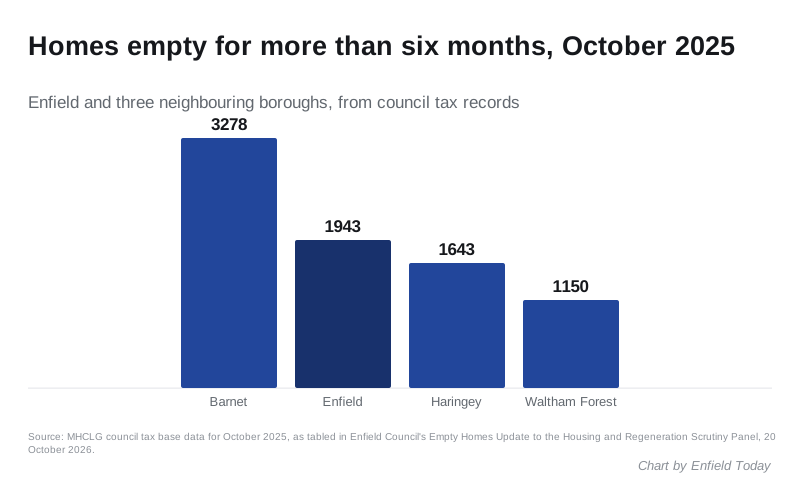
Enfield sits between its neighbours on long-term empties. Barnet recorded 3,278, Haringey 1,643 and Waltham Forest 1,150.
| Borough | All empty homes | Empty more than six months | Second homes |
|---|---|---|---|
| Enfield | 3,482 | 1,943 | 641 |
| Barnet | 5,247 | 3,278 | 1,432 |
| Waltham Forest | 2,292 | 1,150 | 242 |
| Haringey | 2,559 | 1,643 | 1,617 |
What the council is doing
The report says the empty homes service has been rebuilding after the retirement of a long-serving empty homes officer. It has reviewed old cases, checked property records and changed how it manages cases.
Two figures in the report describe the caseload. One paragraph puts it at 252 active cases in 2026/27, including 105 new referrals. Another says the service was managing 243 cases as at September 2026, about 12% of the borough’s long-term empty homes.
Work so far this year includes:
- first letters to owners on most of the caseload, and second letters to owners who did not reply
- tracing owners, checking probate, inspecting properties and reviewing cases
- referring six properties to be leased as temporary accommodation
- assessing homes for refurbishment help, leasing or enforcement
The report notes that many homes counted as empty are not abandoned. They can be held up by probate, ownership disputes, untraceable owners, major disrepair, building work or a pending sale.
The tougher powers, and their limits
The council’s preferred route is to persuade owners, backed by leasing and advice, because it costs least. Officers describe two harder options.
- Empty Dwelling Management Orders let the council take over management of a home, repair it and let it, recovering costs from the rent. The owner keeps the property. The report says these need significant upfront money and suit only a small number of persistent cases.
- Compulsory purchase gives the council ownership, but at high legal, valuation and building costs. Given London prices, officers call it an exceptional step rather than a programme.
The service is rewriting its Empty Homes Strategy for 2027 to 2032. It is due to go to Cabinet in February 2027.
What it means for you
If you own a home that has been empty and unfurnished for more than a year, Enfield charges the highest council tax premium the law allows:
| Time empty and unfurnished | Council tax charged |
|---|---|
| More than 1 year | 200% (double) |
| More than 5 years | 300% (triple) |
| More than 10 years | 400% (four times) |
Some exceptions apply, the report says. The council’s council tax discounts page sets out the current rules.
The report says the council’s first choice is to work with owners on leasing, advice and, where it can, refurbishment help, so owners can let the home without the council buying it.
Have your say